Carbohydrates have the general molecular formula CH2O, and thus were once thought to represent "hydrated carbon". However, the arrangement of atoms in carbohydrates has little to do with water molecules. Starch and cellulose are two common carbohydrates. Both are macromolecules with molecular weights in the hundreds of thousands. Both are polymers (hence "polysaccharides"); that is, each is built from repeating units, monomers, much as a chain is built from its links. The monomers of both starch and cellulose are the same: units of the sugar glucose.
Monosaccharides
Three common sugars share the same molecular formula: C6H12O6. Because of their six carbon atoms, each is a hexose. 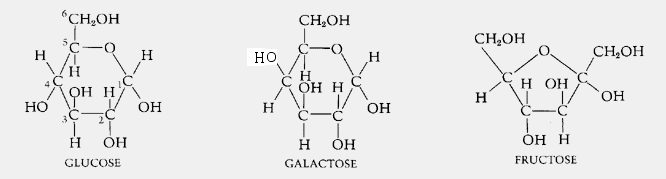
They are:
- glucose, "blood sugar", the immediate source of energy for cellular respiration
- galactose, a sugar in milk (and yogurt)
- fructose, a sugar found in honey
Although all three share the same molecular formula (C6H12O6), the arrangement of atoms differs in each case. Substances such as these three, which have identical molecular formulas but different structural formulas, are known as structural isomers. Glucose, galactose, and fructose are "single" sugars or monosaccharides. Two monosaccharides can be linked together to form a "double" sugar or disaccharide.
Disaccharides
Three common disaccharides:
- sucrose — common table sugar = glucose + fructose
- lactose — major sugar in milk = glucose + galactose
- maltose — product of starch digestion = glucose + glucose
Although the process of linking the two monomers is rather complex, the end result in each case is the loss of a hydrogen atom (H) from one of the monosaccharides and a hydroxyl group (OH) from the other. The resulting linkage between the sugars is called a glycosidic bond. The molecular formula of each of these disaccharides is
All sugars are very soluble in water because of their many hydroxyl groups. Although not as concentrated a fuel as fats, sugars are the most important source of energy for many cells. Carbohydrates provide the bulk of the calories (4 kcal/gram) in most diets, and starches provide the bulk of that. Starches are polysaccharides.
Polysaccharides
There are three primary polysaccharide polymer systems of interest: Starches, Glycogen and Cellulose.
Starches
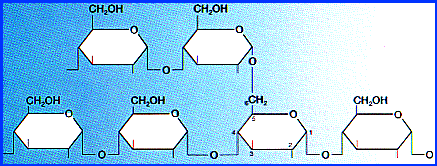 Starches are polymers of glucose. Two types are found:
- amylose consists of linear, unbranched chains of several hundred glucose residues (units). The glucose residues are linked by a glycosidic bond between their #1 and #4 carbon atoms.
- amylopectin differs from amylose in being highly branched. At approximately every thirtieth residue along the chain, a short side chain is attached by a glycosidic bond to the #6 carbon atom (the carbon above the ring). The total number of glucose residues in a molecule of amylopectin is several thousand.
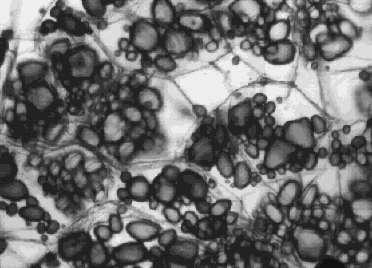
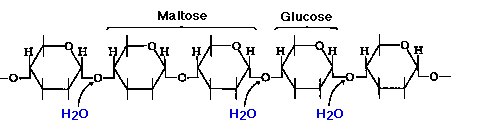 Potato starch Amylase