Proteins are the major building blocks of life. Eukaryotic cells synthesize proteins for thousands of different functions. Some examples:
- to build the components of the cytosol (e.g. microtubules, glycolytic enzymes);
- to build the receptors and other molecules exposed at the surface of the cell embedded in the plasma membrane;
- to supply some of the components of the mitochondria and (in plant cells) chloroplasts;
- proteins secreted from the cell to supply the needs of other cells and tissues (e.g. collagens to support cells, hormones to signal them).
All proteins are synthesized by ribosomes using the information encoded in molecules of messenger RNA (mRNA). This process is called translation and is described in Gene Translation: RNA -> Protein. Our task here is to explore the ways that these proteins are delivered to their proper destinations.
The various destinations for proteins occur in two major sets: (1) one set for those proteins synthesized by ribosomes that remain suspended in the cytosol, and (2) a second set for proteins synthesized by ribosomes that are attached to the membranes of the endoplasmic reticulum (ER) forming "rough endoplasmic reticulum" (RER). This electron micrograph (courtesy of Keith Porter) shows the RER in a bat pancreas cell. The clearer areas are the lumens. So the first decision that must be made as a ribosome begins to translate a mRNA into a polypeptide is whether to remain free in the cytosol or to bind to the ER.
Pathways Through the Endoplasmic Reticulum (ER)
The decision to enter the ER is dictated by the presence of a signal sequence on the growing polypeptide. The signal sequence consists of the first portion of the elongating polypeptide chain (so the signal sequence occurs at the amino terminal of the polypeptide). Typical signal sequences contain 15–30 amino acids. The precise amino acid sequence varies surprisingly from one protein to the next, but all signal sequences include many hydrophobic amino acids.
If a signal sequence is present,
- translation ceases after it has been synthesized.
- The signal sequence is recognized by and is bound by a signal recognition particle (SRP).
- The complex of ribosome with its nascent polypeptide and the SRP binds to a receptor on the surface (facing the cytosol) of the ER.
- The SRP leaves and translation recommences.
- The growing polypeptide chain is extruded through a pore in the ER membrane and into the lumen of the ER.
- The signal sequence is usually clipped off the polypeptide unless the polypeptide is to be retained as an integral membrane protein.
- Other proteins, called molecular chaperones, present in the lumen of the ER, bind the growing polypeptide chain and assist it to fold into its correct tertiary structure.
- Sugar residues may be added to the protein. The process is called glycosylation and often is essential for proper folding of the final product, a glycoprotein.
The 1999 Nobel Prize in Physiology or Medicine was awarded to Dr. Günter Blobel for his discovery of the signal sequence and other intrinsic signals that enable proteins to reach their proper destinations.
Destinations of proteins synthesized within the ER
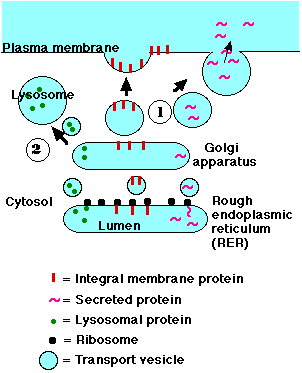
There are two options.
- proteins glycosylated with residues of mannose-6-phosphate will leave the Golgi in transport vesicles that eventually fuse with lysosomes (path 2 in fig. 3.9.1).
- proteins that do not receive this marker, leave in transport vesicles that eventually fuse with the plasma membrane (path 1 in fig. 3.9.1). These are integral membrane proteins that become exposed at the surface of the cell (forming receptors and the like) and proteins in solution within the transport vesicle. These are discharged from the cell. This secretory process is called exocytosis.
The Signal Recognition Particle (SRP)
The signal recognition particle in mammalian cells is made from:
- a single small (7S) molecule of RNA
- six different molecules of protein
It contains binding sites for the signal sequence, the ribosome, and an SRP receptor, also called the docking protein, on the cytosol face of the membranes of the ER.
Destinations of Proteins Synthesized By Free Ribosomes
Ribosomes synthesizing a protein without a signal sequence do not bind to the ER and continue synthesis until the polypeptide is completed. Chaperones are also present in the cytosol that help the protein assume its final three-dimensional configuration. Some of the important destinations for these proteins are:
- The cytosol itself. Such proteins as the enzymes of glycolysis, tubulins for making microtubules, and actin for making microfilaments are simply released from the ribosome and go to work.
- The nucleus. Many proteins — histones, transcription factors, and ribosomal proteins are notable examples — must move from the cytosol into the interior of the nucleus. They are targeted to the nucleus by their nuclear localization sequence, a sequence of 7–41 amino acids of which the basic amino acids lysine and arginine are characteristic members. These proteins are actively transported through pores in the nuclear envelope into the interior.
- Mitochondria. Although the mitochondrion has its own genome and protein-synthesizing machinery, most of the proteins used by mitochondria are Proteins destined for mitochondrion contain a characteristic signal sequence. This is recognized and bound by a chaperone called mitochondrial stimulation factor (MSF). MSF targets the protein to a receptor embedded in the outer membrane of the mitochondrion. Other factors and receptors shepherd proteins through the intermembrane space to the inner mitochondrial membrane (e.g. some proteins of the electron transport chain) and the matrix.
- encoded by genes in the nucleus of the cell
- synthesized in the cytosol
- must be imported into the mitochondrion.
- Chloroplasts. Chloroplasts, like mitochondria, have their own genome and their own protein-synthesizing machinery. But also like mitochondria, most of the proteins used in chloroplasts are encoded by genes in the nucleus of the cell, are synthesized by ribosomes in the cytosol, and must then be imported into the chloroplast. Proteins destined for chloroplasts are recognized by their characteristic transit sequence. Chaperones are also needed to get them to their final destination: stroma, thylakoid membrane, etc.
- Peroxisomes. Proteins destined for peroxisomes are synthesized with a peroxisomal targeting signal (PTS) that binds to a receptor molecule that takes the protein into the peroxisome and then returns for another load.
Two peroxisomal targeting signals have been identified:
Each has its own receptor to take it to the peroxisome.- a 9-amino acid sequence at the N-terminal of the protein
- a tripeptide at the C-terminal.