
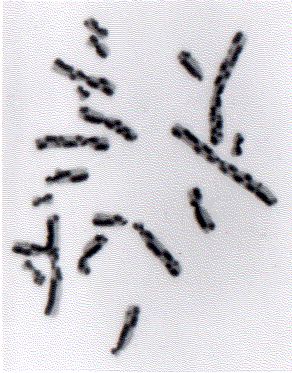
Most eukaryotes have several to many pairs of chromosomes, and we might expect that at metaphase of mitosis the chromosomes would align at the metaphase plate at random so that some containing the immortal DNA strand would go to one pole; the remainder to the other. And this is generally the case. However, there may be some exceptions.
Stem cells divide to produce two daughter cells:
- one that will continue as a stem cell and
- one that will go on to differentiate.
There is evidence that when some types of stem cells divide, for example a subset found in skeletal muscle, the chromatids containing the immortal strand all line up on one side of the metaphase plate and the daughter cell receiving this set is the one that remains a stem cell. Although the mechanism by which this occurs is unknown, one can appreciate a potential value to the organism. Errors (mutations) in DNA occur most often during its replication. By keeping the original template in the stem cell population, introduced errors (mutations) disappear when the differentiated cell dies at the end of its useful life. Another possible advantage of nonrandom segregation of parental vs. newly-synthesized DNA: it may assure that epigenetic alterations of their respective DNA strands are transmitted to the appropriate daughter cells.
(The figure represents a haploid cell with n = 2. Each bar represents one strand of the DNA double helix.)
However, other experiments, with other types of stem cells, find that
- only certain chromosomes (e.g., the X and Y in Drosophila male germline stem cells) preferentially segregate the parental chromatids to the cell that will remain a stem cell;
- and for others, the distribution of immortal strands at metaphase is random, and thus the drawing on the right does not reflect what happens in those cases.