↵
- To separate physical from chemical properties and changes
All matter has physical and chemical properties. Physical properties are characteristics that scientists can measure without changing the composition of the sample under study, such as mass, color, and volume (the amount of space occupied by a sample). Chemical properties describe the characteristic ability of a substance to react to form new substances; they include its flammability and susceptibility to corrosion. All samples of a pure substance have the same chemical and physical properties. For example, pure copper is always a reddish-brown solid (a physical property) and always dissolves in dilute nitric acid to produce a blue solution and a brown gas (a chemical property).
Physical properties can be extensive or intensive. Extensive properties vary with the amount of the substance and include mass, weight, and volume. Intensive properties, in contrast, do not depend on the amount of the substance; they include color, melting point, boiling point, electrical conductivity, and physical state at a given temperature. For example, elemental sulfur is a yellow crystalline solid that does not conduct electricity and has a melting point of 115.2 °C, no matter what amount is examined (Figure
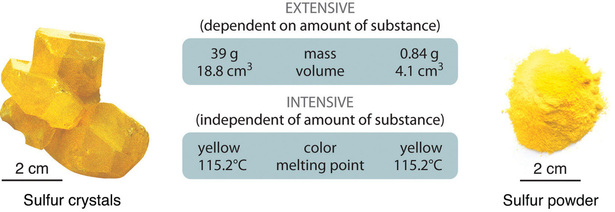
Although mass and volume are both extensive properties, their ratio is an important intensive property called density (
Pure water, for example, has a density of 0.998 g/cm3 at 25 °C. The average densities of some common substances are in Table
| Substance | Density at 25 °C (g/cm3) | Substance | Density at 25 °C (g/cm3) |
|---|---|---|---|
| blood | 1.035 | corn oil | 0.922 |
| body fat | 0.918 | mayonnaise | 0.910 |
| whole milk | 1.030 | honey | 1.420 |
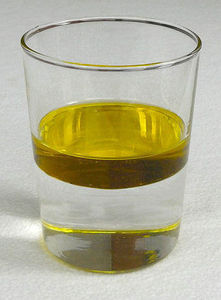
Physical Property and Change
Physical changes are changes in which no chemical bonds are broken or formed. This means that the same types of compounds or elements that were there at the beginning of the change are there at the end of the change. Because the ending materials are the same as the beginning materials, the properties (such as color, boiling point, etc) will also be the same. Physical changes involve moving molecules around, but not changing them. Some types of physical changes include:
- Changes of state (changes from a solid to a liquid or a gas and vice versa)
- Separation of a mixture
- Physical deformation (cutting, denting, stretching)
- Making solutions (special kinds of mixtures) .
As an ice cube melts, its shape changes as it acquires the ability to flow. However, its composition does not change. Melting is an example of a physical change (Figure
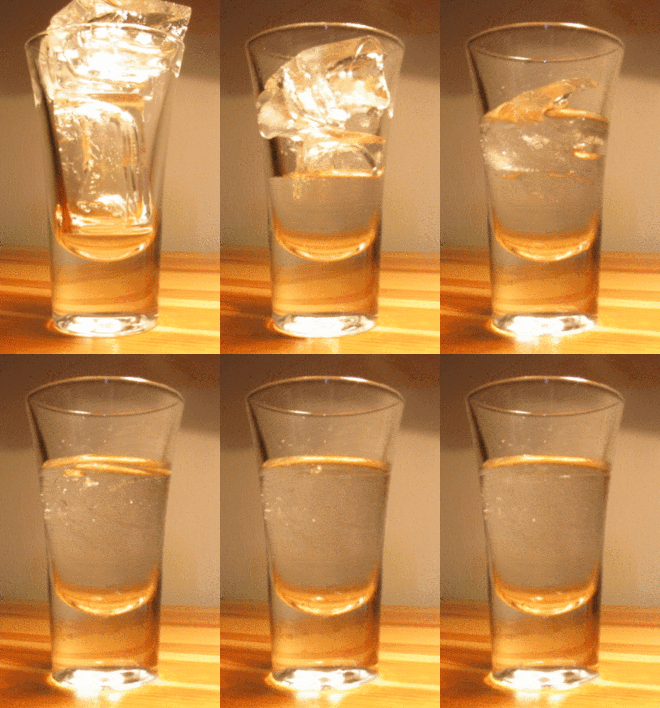
Figure
Chemical Properties and Change
Chemical changes occur when bonds are broken and/or formed between molecules or atoms. This means that one substance with a certain set of properties (such as melting point, color, taste, etc) is turned into a different substance with different properties. Chemical changes are frequently harder to reverse than physical changes.
One good example of a chemical change is burning paper. In contrast to the act of ripping paper, the act of burning paper actually results in the formation of new chemicals (carbon dioxide and water, to be exact). Another example of chemical change occurs when water is formed. Each molecule contains two atoms of hydrogen and one atom of oxygen chemically bonded.
Another example of a chemical change is what occurs when natural gas is burned in your furnace. This time, before the reaction we have a molecule of methane,
The combustion of magnesium metal is also chemical change (Magnesium + Oxygen → Magnesium Oxide):
as is the rusting of iron (Iron + Oxygen → Iron Oxide/ Rust):
Using the components of composition and properties, we have the ability to distinguish one sample of matter from the others.
Different Definitions of Changes: Different Definitions of Changes, YouTube(opens in new window) [youtu.be]
Different Definitions of Properties: Different Definitions of Properties, YouTube(opens in new window) [youtu.be]
References
- Petrucci, Bissonnette, Herring, Madura. General Chemistry: Principles and Modern Applications. Tenth ed. Upper Saddle River, NJ 07458: Pearson Education Inc., 2011.
- Cracolice, Peters. Basics of introductory Chemistry An active Learning Approach. Second ed. Belmont, CA 94001:Brooks/Cole, 2007.
Contributors and Attributions
- Samantha Ma (UC Davis)